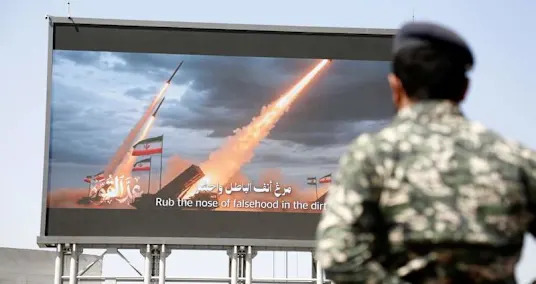
Part of the question for Israel is how many of the missiles, many of which have been covered in rubble, can be salvaged and are only temporarily inaccessible to Iran?
Although the majority of the IDF believes that Iran only has several hundred ballistic missiles left, which can reach Israel from its original 2,500 total, IDF sources have admitted to The Jerusalem Post that no one really knows for certain.
The exchange came after Channel 12 reported on Saturday night from air force IDF Col. "T" that the Islamic Republic still has more than 1,000 ballistic missiles left, directly contradicting the prior IDF estimate of several hundred missiles.
In the exchange between the Post and the IDF, the military first backed the prior estimates that Iran had several hundred missiles left, but then added that no one really knows for sure.
How many missiles are salvageable after Israeli strikes?
Part of the open question is how many of the missiles, which have been covered in rubble, can be salvaged and are only temporarily inaccessible to Iran?
Within that question, there is a subcategory between more mild rubble cave-ins and larger cave-ins.

In some cases, Iran has developed bulldozer teams and techniques to uncover caved-in missile teams or silos within less than a day, according to foreign sources.
For such situations, the ballistic missiles might not only still be part of Iran's long-term arsenal, but might be usable even in the short-term.
Missile launchers are an entirely additional part of the picture.
At multiple points, the IDF has hedged on how many Iranian ballistic missile launchers have been destroyed and how many have been buried and neutralized, with the average being around 50% destroyed and 50% buried out of around 70-80% which have been put out of commission at least for some period of time.
Confusingly, at times the US and the IDF have said that Iran's missile capabilities were reduced by 90%, but then at other times Iran's missile rate has sometimes temporarily risen again.
Iran's firing rate declining over course of war
Generally, Iran's missile rate fell below 20 missiles per day by day four of the war, and in recent weeks fell even lower.
All of these questions leave many open issues which defy easy categorization and attempts to arrive at a set number of what Iran has left on the missile front.
Despite these questions, there are some relatively set numbers that help frame the issue.
For example, Israel knows that Iran has fired over 500 missiles at it.
The Gulf states have publicized that Iran has fired around 1,300 missiles at them collectively.
The IDF has repeated that Iran had around 2,500 missiles at the start of the war, which would leave them with fewer than 700 missiles even if the IDF had not destroyed any.
Presuming the IDF has destroyed at least a few hundred, then Iran would have only a few hundred missiles left.
There is still the possibility that the IDF underestimated the total number of missiles that Iran possessed at the start of this war.
This has occurred before with the IDF having said in June 2025 that Iran had 2,500 missiles, and revising that number months later to 3,000 missiles.
LATEST POSTS
- 1
 Pick Your Favored kind of salad
 - 2More loons are filling Maine's lakes with their ghostlike calls
- 3Astronauts on the ISS watched NASA's historic Artemis 2 launch from space
- 4The Starbucks for Life game is back, along with your chance to win a 'Bearista' cold cup. Here's how to get your paws on one.
- 5Former United Launch Alliance CEO Tory Bruno joins competitor Blue Origin for national security projects





- Vote in favor of your Number one method for commending a birthday
- East Germany Somehow Built a Real Sports Car and It Was Wild
- Pick Your Favored kind of books
- 6 Web-based Lawful Administrations: Extensive Surveys and Elements
- The Best Internet based Courses for Expertise Improvement
- Get away from the Tedious Drudgery: Go into Business Today!
- I asked ChatGPT who would win a Golden Globes. Here's what it got right — and totally wrong.
- Exclusive-Drugmakers raise US prices on 350 medicines despite pressure from Trump
- CDC studies show value of nationwide wastewater disease surveillance, as potential funding cut looms