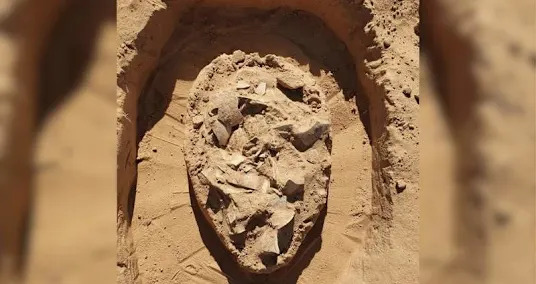
The eggs were discovered near the remains of a campfire believed to have been connected to prehistoric desert nomads who collected, cooked, and ate the eggs at the site.
A cache of ostrich eggs dated from approximately 7,000-years-ago was discovered at an archaeological site near Nitzana in southern Israel, the Israel Antiquities Authority (IAA) said in a Sunday social media post.
The eggs were discovered near the remains of a campfire believed to have been used by prehistoric desert nomads who collected, cooked, and ate them at the site.
"The proximity of the eggs to the fire and the manner in which they were found indicate that this was not a natural dispersal, but a deliberate collection," IAA archaeologist and researcher of nomadic cultures in the Negev and Arava Lauren Davis said. "One of the eggs was found right inside the hearth of the fire, a fact that strengthens the idea that they were used for food.”
Davis explained that these types of sites are often quickly covered by dunes and then exposed again over thousands of years as the sands shift in the wind.
"Sites of this type are quickly covered by dunes, and are exposed as the sands move over hundreds and thousands of years. This fact allowed for the exceptional preservation of the eggs, which are usually not preserved. Fortunately, the excavation provided us with a glimpse into the lives of the nomads who roamed here at that time."

Other finds discovered in Nitzana area
Earlier this month, archaeologists from Ben-Gurion University of the Negev (BGU) discovered a 1,400-year-old church at Nitzana National Park on the Israel-Egypt border, dating to the Byzantine and Early Islamic periods (fifth to seventh century CE).
The church, located on the main road leading to Saint Catherine Monastery and Mount Sinai, is the sixth to be discovered at the site and served both residents of the ancient city of Nessana (Nitzana) as well as pilgrims arriving in the area.
Archaeologists also uncovered a large hospice and bathhouse complex, complete with marble-clad tubs, and several preserved mosaics were also found at the site.
LATEST POSTS
- 1
 More people are addicted to marijuana, but fewer of them are seeking help, experts say
 - 2Vote In favor of Your Number one Sort Of Blossoms
- 3Taylor Swift's 'The End of an Era' docuseries: Everything you need to know, plus how to watch for less
- 4SpaceX launches Italian Earth-observing satellite to orbit on the 1st mission of 2026 (video)
- 5Astronomers detect black hole blasting winds at incredible speeds


- Poll: 62% of Americans would oppose U.S. military action in Greenland
- How to watch Dick Clark’s New Year’s Rockin’ Eve with Ryan Seacrest: Start time, TV channel, performers and more
- Telescope in Chile captures stunning new picture of a cosmic butterfly
- McDonald's is bringing two 'KPop Demon Hunters' meals to McDonald's. Here's what they include and when they launch.
- Track down Your Optimal Conservative Vehicle: Famous Brands to Consider
- Fire Allegedly Triggered by Wedding Cake Sparkler Causes Venue to Go Up in Flames, Leaving Groom with Second-Degree Burns
- Are your hormones imbalanced? Doctors explain how to know if you need testing
- Venezuelans in Madrid celebrate Maduro's capture
- Exemplary Fragrances: A Manual for Notorious Scents